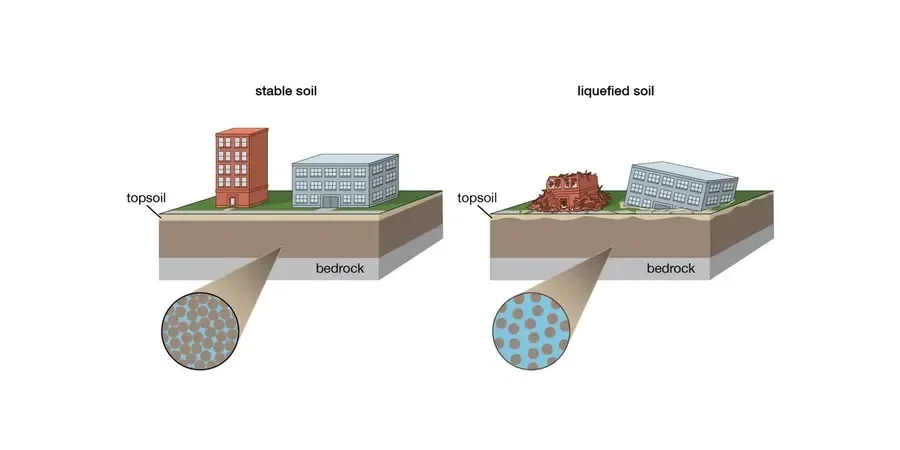
Wigan sits on a complex mix of glacial till, alluvial sands, and the legacy of deep coal mining that shaped this part of Greater Manchester. What we have learned over the years is that seismic risk here is not about big quakes, it is about small to moderate tremors finding the weak spots in saturated silty sand lenses left behind by the River Douglas and its tributaries. When a client asks us to look at a site near the Leeds and Liverpool Canal or out towards Ashton-in-Makerfield, the first thing we check is the groundwater table. It is often higher than people think, and that is what turns an ordinary sand into a potential liquefaction problem. A proper soil liquefaction analysis in Wigan means understanding both the natural geology and the man-made ground, because old backfilled mine shafts and colliery spoil can behave unpredictably under cyclic loading. We pair this local knowledge with the framework of BS EN 1998-5 and the screening charts from the NCEER guidelines, so you get an assessment that is grounded in the site, not just a textbook. For projects where deeper profiling is needed, we often recommend a CPT test to pick up thin sand seams that a standard borehole might miss entirely.
In Wigan, the critical liquefiable layers are often thin silty sand seams at the till-alluvium boundary, which standard borehole spacing can easily miss.
Process overview
A few years back we worked on a proposed apartment block in the Wallgate area, right where the alluvial flats meet the coal measures. The boreholes showed medium dense sand from about three metres down, and the groundwater was sitting at two metres below ground level. On paper it looked fine, but when we ran the cyclic stress ratios against the corrected SPT blow counts, the factor of safety against liquefaction dropped below 1.1 in two of the four layers. That is the kind of thing that keeps you awake. We ended up recommending Improvement with stone columns and a raft foundation to manage differential settlement. That project taught us something important: in Wigan, the critical layers are often thin, maybe half a metre thick, and they sit right at the boundary between the glacial till and the fluvial deposits. If you only test every two metres, you can walk right past the problem. Our approach now is to demand continuous sampling or CPT soundings across the transition zones, and to run grain-size distribution tests on every suspect sample to check the fines content. A sand with 15% fines behaves very differently from a clean sand with less than 5% passing the 75-micron sieve, and the NCEER-based procedures are sensitive to that distinction.
Local context
The kit we rely on most for liquefaction assessment around Wigan is the electric cone penetrometer, pushed by a tracked rig that can get into the tight brownfield sites we see so often. The CPT gives us a near-continuous profile of tip resistance and pore pressure, which is exactly what you need to spot a thin silt layer that could trap water and trigger liquefaction during a tremor. On sites where access is too tight for a 20-tonne CPT truck, we fall back to SPT drilling with an automatic trip hammer calibrated to BS EN ISO 22476-3, and we take every precaution to keep the borehole stable through the soft alluvium. The biggest headache in this area is the unknown: unrecorded mine entries, pockets of colliery shale that have been compacted in an uncontrolled way, or old mill foundations buried under a metre of made ground. If the ground has been disturbed by mining, the density of the sand can vary wildly over just a few metres, and that variability feeds straight into the liquefaction analysis. We have seen sites where one CPT sounding gives a clean bill of health and the next, ten metres away, shows loose sand right at the groundwater interface. That is why we never rely on a single data point for a soil liquefaction analysis in Wigan.
Quick answers
Is Wigan at risk of earthquakes, and does the Building Regulations require a liquefaction assessment?
The UK experiences around 200-300 small earthquakes each year, but most are below magnitude 3. Wigan itself is in a low-to-moderate seismicity zone. Under BS EN 1998-1:2004, the UK National Annex gives a reference peak ground acceleration of 0.04g to 0.06g for much of the region, which generally means no requirement for seismic design unless the ground is particularly susceptible. However, Part A of the Building Regulations requires that the ground be capable of supporting the building safely. If the site investigation reveals loose saturated sands within 15 metres of the surface, a soil liquefaction analysis becomes prudent, even if not explicitly mandated. We advise clients to consider it whenever the groundwater is within 5 metres of ground level and the site lies on alluvial or fluvial deposits.
What does a soil liquefaction analysis cost for a typical residential development site in Wigan?
For a standard residential plot requiring two or three CPT soundings, laboratory grain-size tests, and the full cyclic stress analysis with a written report, you would typically be looking at £1,790 to £3,450 depending on access constraints, depth of investigation, and whether we need to bring in a specialist CPT contractor. Brownfield sites with complex mining history tend toward the upper end because we spend more time correlating the data and checking against historical records.
How long does the analysis take, and what do I get at the end?
The field investigation is usually completed in one to two days on site. Laboratory testing for grain-size distribution and fines content takes about a week. After that, we need roughly two to three weeks to run the calculations, prepare the factor-of-safety plots, estimate settlement, and draft the report. You receive a full interpretative document with clear recommendations: whether the risk is negligible, whether Improvement is needed, or whether a foundation redesign is the safest path. The report is signed by a chartered engineer and is suitable for building control submission and warranty provider review.