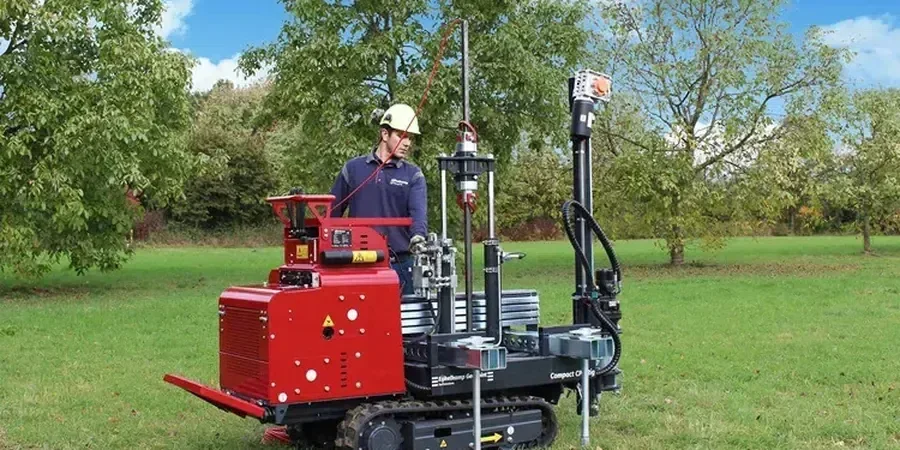
The ground beneath Wigan rarely tells a simple story. Across the borough, from the exposed sandstones near Haigh to the thick glacial tills blanketing the Douglas valley floor, the legacy of the Lancashire Coalfield creates a patchwork of drift, made ground, and weathered bedrock—all within a single site boundary. In our knowledge commissioning site investigations here, borehole logs alone can miss the thin, compressible silt horizons or the shallow, perched water tables that appear in Wigan's drumlin fields. That is why we rely on the CPT (Cone Penetration Test) as a primary profiling tool, pushing a 15 cm² instrumented cone into the subsurface at a constant 20 mm/s while measuring tip resistance, sleeve friction, and dynamic pore pressure in real time. The resulting near-continuous profile often reveals features that a standard cable percussion borehole with SPTs at 1.5 m intervals would overlook. This is particularly critical in Wigan, where the geological transition from the Pennine Middle Coal Measures Formation to Quaternary drift can happen over a distance of less than 30 metres, demanding a resolution that only a properly executed CPT can deliver.
In Wigan's glacial terrain, a CPT profile at 10 mm intervals often catches a 20 cm silt seam that a 1.5 m SPT interval would skip entirely.
Process overview
The rig we mobilise for Wigan projects is a 20-tonne crawler CPT unit fitted with a 15 cm² subtraction-type piezocone, capable of penetrating the dense lodgement till that characterises much of the Greater Manchester region. The cone records three channels simultaneously—qc (corrected cone resistance), fs (sleeve friction), and u2 (pore pressure behind the tip)—at 10 mm depth increments, governed by BS EN ISO 22476-1:2012. On a recent job near the Leeds-Liverpool Canal at Wigan Pier Quarter, the pore pressure dissipation test at 8.5 m identified a drainage boundary within the glacial lake deposits that had been interpreted as a continuous aquifer on the desk study. The data output includes the Friction Ratio (Rf) log and a Soil Behaviour Type (SBT) classification following Robertson (1990, updated 2016), which we cross-reference against laboratory
atterberg limits when the interpreted profile suggests cohesive interbedding. For deeper investigations into the Coal Measures bedrock, we often pair the CPT with a companion
spt drilling borehole, using the SPT to confirm refusal depth and recover disturbed samples for visual classification.
Local context
A common error we observe on Wigan brownfield sites is the assumption that the glacial till is a uniform, competent bearing stratum. The till across the Lancashire Plain frequently contains lenses of glaciolacustrine silt and soft clay, deposited in proglacial lake basins during the Devensian retreat. If a site investigation relies solely on widely spaced boreholes and misses these lenses, the foundation design may underestimate differential settlement—especially under raft or pad foundations for the medium-rise residential blocks now common in the Wigan Central regeneration area. A second risk unique to the coalfield geology is the presence of unrecorded shallow mine workings or bell pits backfilled with colliery spoil. The CPT can detect these zones through a sudden drop in cone resistance and a spike in friction ratio, flagging the need for targeted rotary drilling. Ignoring these indicators can lead to costly grouting programmes mid-construction, or worse, a structural failure that would have been entirely preventable with a high-resolution CPT profile.
Quick answers
How deep can a CPT penetrate in Wigan's glacial till?
In the dense lodgement till common across Wigan, our 20-tonne CPT rig with 200 kN thrust typically achieves depths between 15 and 25 metres. Refusal usually occurs at the top of the Pennine Middle Coal Measures sandstone or mudstone bedrock. In areas with a high cobble and boulder content—common in the drumlinised terrain west of the M6—we may pre-drill through the upper 2–3 metres to avoid cone damage.
What is the cost of a CPT test in Wigan?
A standard CPTu profile in Wigan, including mobilisation, testing, dissipation tests, and an AGS4-compliant report, ranges from £110 to £220 per linear metre, depending on the total depth, site access constraints, and the number of dissipation tests required. For deeper profiles exceeding 20 metres or sites requiring traffic management, the rate may be adjusted at the quotation stage.
Do you need to dispose of spoil from a CPT?
No. The CPT is a zero-spoil investigation method. The cone pushes the soil aside without extracting cuttings to the surface. This is a significant advantage on Wigan brownfield sites where contaminated land regulations would require costly disposal of arisings from conventional drilling.
How does the CPT handle Wigan's old mine workings?
The CPT is not a substitute for rotary drilling into mine workings, but it is an excellent screening tool. A sudden loss of cone resistance coupled with an erratic friction ratio profile often signals a void, collapse feature, or backfilled bell pit. When we identify such an anomaly, we recommend immediate follow-up with rotary open-hole drilling to confirm the extent and depth of the workings.
Which soil parameters can you derive from a CPT in the Coal Measures?
Directly from the cone resistance (qt) and friction ratio (Rf), we derive the undrained shear strength (Su) for cohesive layers, the relative density (Dr) for granular soils, the constrained modulus (M) for settlement analysis, and the small-strain shear modulus (G0) when combined with downhole seismic measurements. For Wigan's glacial till, we also correlate the Soil Behaviour Type Index (Ic) with the overconsolidation ratio (OCR), which is critical for assessing the pre-consolidation pressure in the deep foundation design.