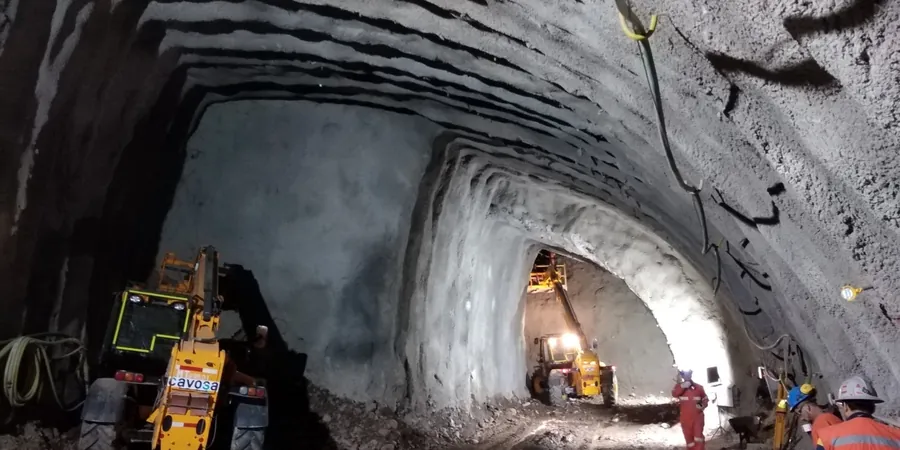
The legacy of shallow coal workings across the Wigan Coalfield means what lies beneath is rarely straightforward. Glacial till overlies Middle Coal Measures in much of the borough, and where the till is absent you get straight into weathered mudstone, siltstone and occasional sand channels that can catch a TBM off guard. The River Douglas corridor introduces alluvium with peat pockets that behave unpredictably under closed-face pressure. We focus on geotechnical analysis for soft soil tunnels that extracts maximum value from every borehole, because in ground this variable the difference between a stable drive and a settlement claim often comes down to how well you read the transition zones. Combining in-situ permeability profiling with detailed logging lets us map groundwater pathways through the Coal Measures before the cutterhead ever touches the face.
In Wigan, the real geotechnical risk is not a single soft layer; it is the vertical transition between glacial till, Coal Measures mudstone, and flooded mine voids.
Local context
Groundwater in the Wigan Coalfield does not behave like a textbook aquifer. Decades of mining have created a connected network of flooded voids, collapsed pillars, and fractured roof rock, so the hydrogeological regime can switch from drained to confined within a few metres of advance. A tunnel face entering the Ince seam horizon at 80 metres depth might encounter hydrostatic pressures that were not predicted by a simple piezometric surface. The other factor that keeps us awake is the presence of undocumented shallow workings, often less than 15 metres below ground in the eastern wards toward Hindley, where historical bell pits and adits were never properly mapped. A geotechnical analysis for soft soil tunnels without targeted probing ahead of the face in these areas leaves the project exposed to sudden crown collapse and, at surface, a depression that can affect terraced housing and canal embankments. We treat every tunnel metre in Wigan as a potential encounter with mining legacy until the ground investigation proves otherwise.
Quick answers
What is the typical cost range for a geotechnical tunnel analysis in Wigan?
For a soft ground tunnel project in the Wigan area, the geotechnical analysis cost typically falls between £3,290 and £11,490. The range depends on the length of the alignment, the number of boreholes required to characterise the Coal Measures and overlying drift, and the complexity of the laboratory testing programme. A short pedestrian underpass with two boreholes sits at the lower end, while a longer sewer or utility tunnel crossing several worked coal seams requires substantially more investigation and analysis, moving the cost toward the upper end.
How does historical coal mining affect tunnel design in Wigan?
Historical mining in the Wigan Coalfield introduces three main challenges: flooded mine voids that can cause sudden groundwater inflow, collapsed workings that create loosened ground with low stand-up time, and subsidence-related fracturing that increases the bulk permeability of the rock mass. We address these by cross-referencing Coal Authority abandonment plans with targeted rotary drilling and geophysical surveys, then designing face support pressures and pre-excavation grouting to manage the residual risk.
Which laboratory tests are most critical for soft ground tunnels in glacial till?
For the glacial till that covers much of Wigan, we prioritise consolidated undrained triaxial tests to get effective stress strength parameters, oedometer consolidation tests to quantify settlement potential, and Atterberg limits to classify the plasticity of the clay matrix. Where sand lenses are present within the till, we also run permeability tests to assess the risk of groundwater drawdown and surface settlement during tunnelling.
What tunnelling methods suit the Wigan ground conditions?
Closed-face methods such as Earth Pressure Balance (EPB) TBMs generally suit the mixed soft ground and Coal Measures conditions in Wigan, because they allow control of face pressure through transitions from till to weathered mudstone. Where the alignment encounters known mine voids, we often recommend pre-treatment with grouting before TBM arrival. For short crossings in the alluvial deposits of the Douglas valley, pipe jacking with face support can be an alternative.