← Home · Laboratory

Grain Size Analysis (Sieve + Hydrometer) in Wigan

Together, we solve the challenges of tomorrow.

READ MORE →

A groundworks contractor in Wigan reached out last month. They hit silty fine sand at 2.8m depth on a residential plot off Warrington Road. The structural engineer refused to sign off the drainage design without a full particle size distribution curve. We collected the bagged sample from site, ran wet sieve and hydrometer in our lab, and emailed the PSD chart within 48 hours. In Wigan, glacial till and pockets of soft alluvium along the Douglas Valley make grain size analysis a non-negotiable step. Our lab processes over 200 gradings a month for projects across Greater Manchester. The wet preparation method per BS 5930 separates silt and clay fractions that dry sieving alone misses. For sites with variable ground, pairing this with an SPT drilling campaign provides the stratigraphic control needed to interpret lab results correctly.

If the fines fraction exceeds 12%, the grading curve alone is not enough — you need the plasticity index to know what you are dealing with.

Process overview

Wigan's industrial legacy shapes the ground. The town grew fast in the 19th century with coal mining, cotton mills, and ironworks. Much of the central area sits on made ground — ash, clinker, demolition rubble — overlying Middle Coal Measures. For any earthworks near the Leeds-Liverpool Canal or the River Douglas, the fines content matters. A soil with over 15% passing 63µm behaves differently under compaction and drainage. Our lab technicians see this daily: samples from the same site in Wigan can swing from sandy gravel to silty clay within 10 metres laterally. That variability is why we recommend combining grading with Atterberg limits whenever the fines fraction exceeds 12%. Knowing the plasticity index alongside the PSD curve tells you whether those fines are silt or active clay — and that distinction drives the engineering decision.
Grain Size Analysis (Sieve + Hydrometer) in Wigan
Technical reference image — Wigan

Local context

Wigan's postcode distribution spans areas where the 2019 BGS GeoSure dataset flags moderate to high shrink-swell hazard in the south-eastern wards. That is a direct consequence of clay-rich drift deposits. If a site investigation skips hydrometer analysis, the clay fraction below 2µm stays invisible. The result is an over-optimistic drainage design or an underestimation of frost susceptibility. We have seen soakaway tests fail in Wigan's glacial till because the grading report missed the 8-12% clay fraction — it only shows up below 63µm. For road sub-base, the Specification for Highway Works (Series 500 and 600) sets strict grading envelopes. Non-compliance means the material gets rejected on site. A CBR test on the same material then confirms whether the compacted layer meets the stiffness requirement, closing the loop between lab grading and field performance.

Need a geotechnical assessment?

Reply within 24h.

Email: contact@geotechnical-engineering.biz

Technical parameters


ParameterTypical value
StandardBS 5930:2015 + A1:2020 / BS 1377-2:1990
AccreditationUKAS ISO/IEC 17025 (testing lab 4782)
Sieve range63 mm to 63 µm (wet sieving)
Hydrometer range63 µm down to 2 µm
Sample mass requiredMinimum 2 kg (fine soils), 10 kg (gravelly)
Turnaround (standard)3 working days from receipt
Turnaround (express)24 hours — surcharge applies
ReportingPSD chart, D10/D30/D60, Cu, Cc, compliance statement

Additional services

01

Wet Sieve Analysis (BS 1377-2)

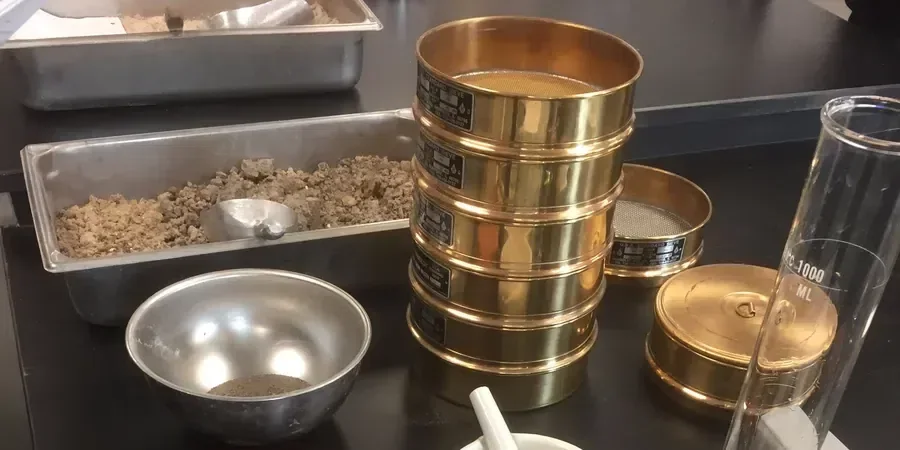
Covers the coarse fraction from 63mm down to 63µm. Sample is washed over a 63µm sieve, oven-dried, and shaken through a stack of BS sieves. We report percentage retained and cumulative passing. Standard turnaround is 3 working days; 24h express available for Wigan sites.

02

Hydrometer Sedimentation (BS 1377-2 / BS 5930)

For the fine fraction below 63µm. Dispersant and sedimentation cylinder method, with readings at 0.5, 1, 2, 4, 8, 15, 30, 60 minutes and 24 hours. Combined with sieve data to produce a single continuous grading curve from 63mm down to 2µm.

Reference standards

BS 5930:2015 + A1:2020 — Code of practice for ground investigations, BS 1377-2:1990 — Methods of test for soils for civil engineering purposes: Classification tests, Eurocode 7 (BS EN 1997-1:2004) — Geotechnical design: General rules, UKAS ISO/IEC 17025:2017 — Testing laboratory accreditation, Specification for Highway Works (SHW) Series 600 — Earthworks

Quick answers

How much does a grain size analysis cost in Wigan?

A standard combined sieve and hydrometer analysis costs between £80 and £140 per sample, depending on the number of sieves requested and whether express turnaround is needed. Bulk pricing applies for five or more samples from the same Wigan site.

What sample mass do you need for the lab?

For fine-grained soils we need at least 2 kg. For gravelly soils a minimum of 10 kg is required to ensure the coarse fraction is representative. We provide sample bags and collection from any site within the Wigan borough at no extra charge.

How is the hydrometer test different from just sieving?

Sieving stops at 63 µm — the opening of the finest standard mesh. Everything passing that sieve is pan material. The hydrometer measures particle sizes from 63 µm down to 2 µm by tracking the sedimentation rate of suspended particles in a dispersant solution. Without it you cannot quantify the silt and clay fractions separately.

What are Cu and Cc and why do they matter?

Cu is the coefficient of uniformity (D60/D10). Cc is the coefficient of curvature (D30²/D60×D10). Together they classify a soil as well-graded or poorly-graded. A well-graded granular soil compacts better and drains less erratically. These numbers go straight into the earthworks specification and the geotechnical interpretive report.

Can you test contaminated samples from brownfield sites in Wigan?

Yes. We handle Category B and C soils under our health and safety protocol. Samples are sealed and processed in a ventilated workstation. We need a copy of the site's contamination risk assessment with the sample submission form.
Location and service area

We serve projects across Wigan and its metropolitan area.

View larger map