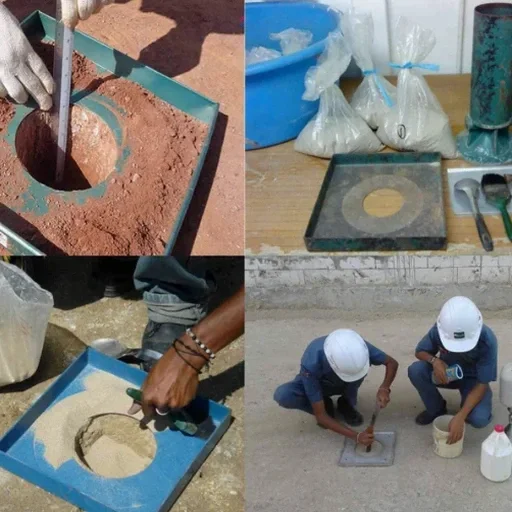
The ground beneath Wigan tells a story of industrial transformation. The compact sands and gravels around the Douglas Valley respond to compaction quite differently than the reworked colliery spoil and made ground that characterises districts like Ince or Platt Bridge. Getting the compaction right in one area doesn't commit to the same result half a mile away. We apply the sand cone field density test to measure actual in-place density against the laboratory benchmark, whether the project involves a residential plot in Standish, a commercial slab on the Martland Park estate, or infrastructure reinstatement along the Leeds and Liverpool Canal corridor. The method remains the practical reference for compaction verification in the UK, and our team carries it out under BS 1377-9 procedures, pairing it with Proctor tests when the lab optimum needs confirmation or updating for a specific borrow source.
A passing density test on a thin compacted layer can hide poor compaction lower down. Correlating sand cone results with visual soil logs from trial pits reduces that risk.
Local context
A common mistake on Wigan jobs is relying solely on proof-rolling or observation to sign off fill compaction. A firm running a tracked excavator over the lift may see no visible deflection and call it good, only to have the local building control officer ask for density records later. Without sand cone results, a soft layer buried beneath a competent crust can go unnoticed until differential settlement cracks appear in the floor slab or the pavement surface begins to rut after the first wet winter. In areas with historic shallow mine workings, such as parts of Abram or Bickershaw, inadequate compaction can accelerate water ingress into old voids and trigger localised collapse. The sand cone method provides a defensible, numeric record of compaction achievement, referenced to a laboratory Proctor curve, that satisfies NHBC, local authority, and Highways England specification requirements.
Quick answers
How much does a sand cone density test cost in Wigan?
A single sand cone test typically falls between £90 and £120, depending on access conditions and the number of tests scheduled per site visit. The rate per test reduces when multiple points are grouped on the same day, as the technician can calibrate the sand cone once and move efficiently between locations.
How many density tests are needed for a typical housing plot foundation?
For a standard residential plot in the Wigan area, the frequency is usually specified by the engineer or NHBC requirements, often one test per lift per 50 to 100 m² of compacted area. A single plot might need three to six tests spread across the building footprint, with additional points at service trench crossings where reinstatement compaction is critical.
Can the sand cone method be used on demolition rubble or coarse colliery spoil?
The standard sand cone method per BS 1377-9 is limited to material with a maximum particle size around 37.5 mm. When Wigan sites contain coarser colliery spoil, brick rubble, or demolition arisings, we often recommend a larger replacement method or combine sand cone testing with Test pits to visually assess the fill matrix and decide on the most appropriate verification approach.