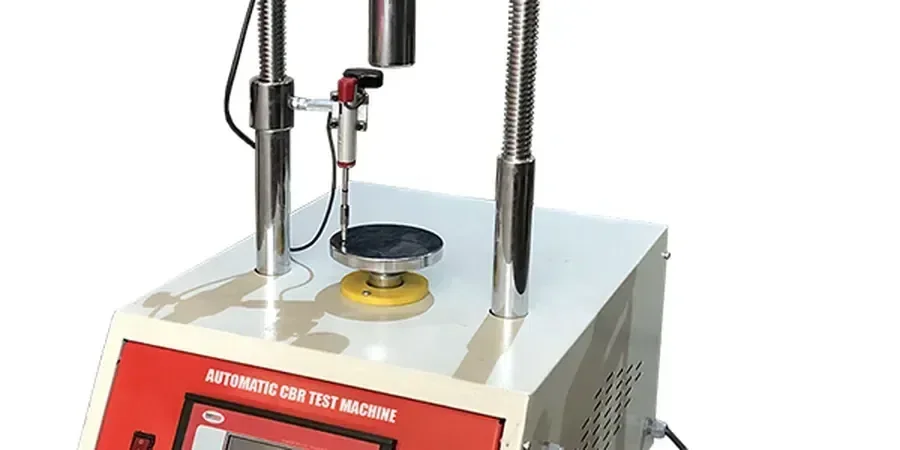
Wigan’s mining heritage left more than coal seams beneath its streets—it left a patchwork of colliery spoil, glacial till, and reworked Pennine drift that makes every pavement design a case study in variability. When Lancashire County Council or National Highways commissions a road upgrade along the A49 corridor, the first question is always subgrade strength. The laboratory CBR test answers that with a number, but the real value comes from interpreting that figure against the site’s geology. The Pennine Lower Coal Measures weather into stiff, fissured clays that swell and shrink with the seasons, and a soaked CBR value rarely tells the whole story unless you also understand the in-situ moisture regime. We pair grain-size analysis with the test to flag fines migration risk and confirm whether the material falls into a frost-susceptible bracket under HAUC Specification for Highway Works Clause 632. For deep sections where the Highways Agency’s Design Manual for Roads and Bridges (DMRB CD 225) governs, in-situ permeability tests inform the drainage layer design that protects the capping from saturation.
A single soaked CBR value below 2% on Wigan’s glacial till can add six figures to a road project if the capping design is not adjusted early.
Local context
BS EN 1997-1:2004 (Eurocode 7) Clause 2.4.6.1 requires that ground investigation be sufficient to establish the mechanical properties of the subgrade. In Wigan, that requirement bites harder than on a greenfield site in Cheshire, because the legacy of bell pits and shallow room-and-pillar workings means the subgrade can change character over a few metres—colliery spoil, natural till, or backfilled shafts with zero bearing capacity. A CBR test performed only on surface samples misses the deeper story. The Coal Authority’s interactive map shows recorded mine entries across the borough; we cross-reference those with the test grid to ensure no specimen inadvertently represents a backfilled shaft rather than undisturbed formation. When the Design Manual for Roads and Bridges CD 225 is applied, a CBR below 2% triggers mandatory capping replacement to a depth of 600 mm, and if the underlying material is colliery shale with residual sulphate above 0.5 g/L, the cement-stabilised layer requires a sulfate-resistant binder specified under BRE Special Digest 1.
Reference standards
BS 1377-4:1990 – Methods of test for soils for civil engineering purposes: Compaction-related tests, BS EN 13286-47:2012 – Unbound and hydraulically bound mixtures: Test method for California Bearing Ratio, Eurocode 7 (BS EN 1997-1:2004) – Geotechnical design: General rules, HAUC Specification for Highway Works, Series 600 – Earthworks, DMRB CD 225 – Design for new pavement construction
Quick answers
How much does a laboratory CBR test cost in Wigan?
A standard single-point CBR test with compaction and 96-hour soaking typically falls between £90 and £160, depending on whether the specimen is remoulded from bulk samples or taken as an undisturbed core. Multi-point programmes for pavement design—for example, three CBR tests at different compaction energies—reduce the per-point rate and usually sit around £250–£320 for the set. All prices include the full test report with swell monitoring and CBR-versus-penetration curves.
How long does a soaked CBR test take from sample collection to report?
Allow eight working days as a practical minimum: one day for sample preparation and compaction, four days for the standard 96-hour soaking period, and three days for the penetration test, data reduction, and reporting. If the project programme is tight and the material is granular with low plasticity, we can sometimes run a 24-hour accelerated soak under agreement with the designer, which delivers results in three working days.
What CBR value does National Highways require for road pavements in the Wigan area?
Under DMRB CD 225, the design CBR for the subgrade is typically taken as the lower quartile of the test results. For a flexible pavement carrying more than 30 million standard axles, a formation CBR of at least 5% is expected; values between 2% and 5% trigger a capping layer, and anything below 2% requires capping replacement with a minimum 600 mm of Class 6F2 or stabilised material. We have seen several A-road widenings around the M6 corridor where the design CBR was governed by a single poor result in glacial till.
Can you test unbound granular sub-base materials with the CBR method?
Yes, BS EN 13286-47 is specifically written for unbound and hydraulically bound mixtures. We compact the granular sub-base at optimum moisture content in the CBR mould and run the penetration test without soaking, because free-draining Type 1 sub-base does not develop pore pressure under load. The result feeds directly into the foundation class verification required by the Specification for Highway Works Clause 803.
What is the difference between a laboratory CBR and a field CBR test?
The laboratory CBR test measures the strength of a specimen compacted to a controlled density and moisture content—it tells you what the material can achieve under specification conditions. A field CBR test, by contrast, measures the in-situ strength at natural moisture content and density. On Wigan’s boulder clay, the field value is often 30–50% lower than the laboratory value because of fissuring and macro-fabric that the remoulded specimen destroys. For pavement design, the soaked laboratory CBR is the conservative input, and we recommend using it for the formation unless undisturbed sampling is practical.