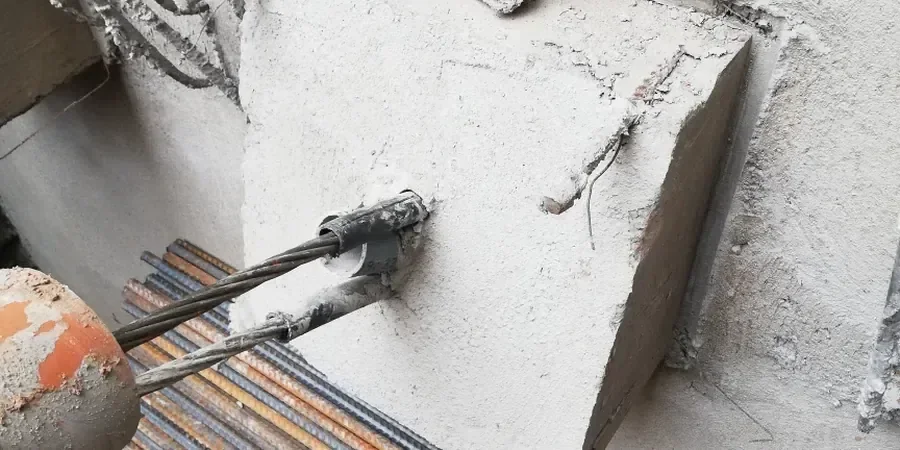
Wigan’s industrial legacy, from its 18th-century canal and milling expansion to its 19th-century deep coal mining boom, has left a subsurface riddled with shafts, abandoned drifts, and variable fill. When modern regeneration projects push deeper for basements or cut into slopes along the Douglas valley, gravity solutions often fall short and the load must be transferred to competent ground through anchoring. In our knowledge across the borough, designing an anchor in Wigan means reconciling the demands of BS 8081:2015 and Eurocode 7 with a ground model that can switch from competent Pennine Middle Coal Measures sandstone to soft alluvial silts within a single borehole. A systematic CPT campaign helps delineate these transitions before committing to bonded lengths, particularly where historic backfill masks the natural strata.
A permanent anchor in Wigan's coal measures without double corrosion protection is a liability—mine water chemistry here demands absolute barrier integrity.
Process overview
The rigs we mobilise for anchor installation in Wigan are typically Klemm 806 or Casagrande C6XP machines, selected for their ability to drill through mixed coal measure sequences—sandstone bands alternating with weak mudstone and occasional coal seams—while maintaining hole stability with rotary percussive duplex methods. In confined sites behind Victorian terraces along Wallgate, we switch to compact Mastrad or Comacchio units that can work under 4.5 m headroom. A critical design input is the residual shear strength along the bond zone, which for weathered mudstone can drop below 50 kPa unless the bore is thoroughly flushed. Where permanent anchors must resist aggressive mine water with pH values dipping below 4, we specify double-corrosion protection (DCP) with factory-applied epoxy coating and corrugated HDPE sheathing tested to BS EN 1537:2013. Load testing follows the stringent acceptance criteria in BS 8081, including cyclic loading for temporary anchors and extended creep monitoring for permanent ties supporting structures like the reinforced concrete abutments on the Leeds and Liverpool Canal corridor.
Local context
The contrast between Wigan’s central low-lying districts, such as the area around Mesnes Park built on alluvial sands and clays of the River Douglas floodplain, and the elevated colliery plateaus near Pemberton illustrates the anchor design challenge perfectly. In the floodplain, anchor bond zones often terminate in soft, compressible silts where creep deformation under sustained load can be significant, demanding longer bonded lengths and step-loading during suitability tests. Up in Pemberton, shallow abandoned mine workings introduce the risk of sudden grout loss into voids, which not only wastes material but can leave the fixed anchor under-grouted and dangerously compromised. Across the borough, we routinely combine anchor design with grouting pre-treatment—compaction or permeation grouting to stabilise collapsed workings and fill voids before anchor drilling starts.
Reference standards
BS 8081:2015 – Code of practice for grouted anchors, BS EN 1537:2013 – Execution of special geotechnical works: Ground anchors, BS EN 1997-1:2004 (Eurocode 7) – Geotechnical design, Part 1: General rules, BS 5930:2015 – Code of practice for ground investigations, BS EN ISO 22477-5:2018 – Geotechnical investigation and testing: Testing of geotechnical structures, Part 5: Anchor testing
Quick answers
What's the typical cost of an anchor design package for a Wigan project?
For a standard design package covering temporary and permanent anchors for a single retaining wall in Wigan, fees range from £780 for a straightforward scheme with accessible ground data to £2,600 for a more complex assignment involving multiple anchor rows, DCP specification, and load test supervision.
How do abandoned coal mines in Wigan affect anchor design?
Abandoned mine workings, especially in the Pemberton and Ince areas, can cause sudden grout loss during anchor installation. We address this by specifying pre-injection grouting to fill voids and by designing the fixed anchor in competent sandstone below the worked seams, confirmed through pre-construction rotary drilling.
What corrosion protection level is required for permanent anchors in Wigan?
Given the acidic mine water (pH often 3.5–5.0) and high sulphate content in Wigan's Coal Measures, we mandate double corrosion protection (DCP) for all permanent anchors, comprising epoxy-coated strand, corrugated HDPE sheathing, and factory-injected cement grout, in accordance with BS EN 1537 and BS 8081.
Can anchors be used in Wigan's alluvial soils near the River Douglas?
Yes, but the bond zone must be designed with caution. The soft alluvial silts and clays near the Douglas floodplain exhibit significant creep under sustained load, so we extend bonded lengths, specify post-grouting techniques to improve bond, and run extended creep tests to verify performance before lock-off.
What load testing do you perform on anchors in Wigan?
All temporary anchors undergo acceptance testing to 1.25 times the working load. Permanent anchors are proof-loaded to 1.5 times the SLS load, with creep monitoring over at least 30 minutes per load step. For critical structures, we also install permanent load cells for ongoing remote monitoring.