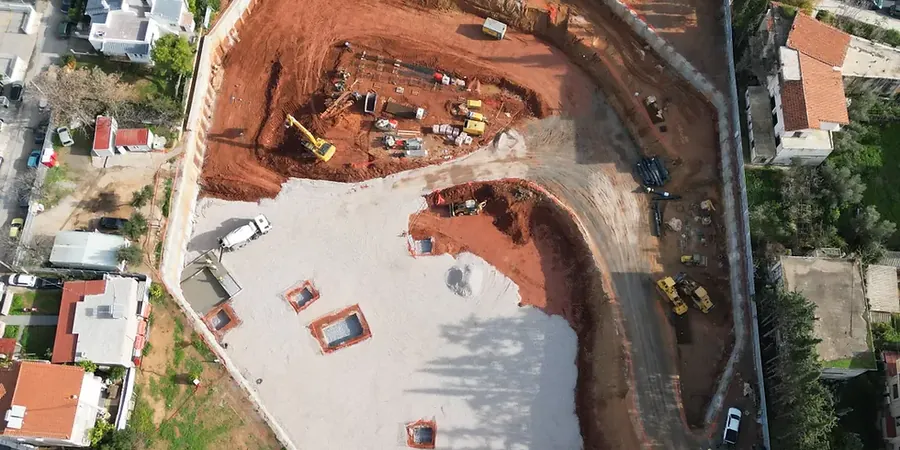
BS EN 1997-1:2004 governs every deep excavation design we produce, and in Wigan the ground profile makes that framework essential rather than optional. The town sits on Middle Coal Measures overlain by Devensian till, a sequence that places weathered mudstone and sandstone within reach of basement-level digs while the upper metres are dominated by stiff to very stiff boulder clay. Borehole logs from the Wigan Central and Lower Ince areas consistently show groundwater perched within the drift, with some horizons artesian where the till pinches out against buried sandstone channels. Designing a shoring system here without understanding those perched pressures leads straight to base instability. Our team runs effective stress analysis for every cut, pairing laboratory shear strength data from the Coal Measures with in-situ permeability values measured in boreholes across the site. The result is a temporary works design that accounts for Wigan's layered geology rather than assuming a single idealized ground model, which is why we often combine excavation design with an in-situ permeability programme to capture the real drainage behaviour of the till before fixing the dewatering strategy.
Wigan's Devensian till can sustain near-vertical cuts for days but relax rapidly once groundwater finds a path through fissures — drainage design and shoring stiffness must be solved together, not sequentially.
Process overview
Comparing two sites only a mile apart in Wigan tells the story. A development near Mesnes Park, sitting on weathered sandstone at shallow depth, behaves as a drained excavation where water flows through joint networks and the shoring needs to handle moderate earth pressures with straightforward dewatering. Move east toward the Douglas Valley at Newtown, and the ground shifts to soft alluvium overlying laminated clays with pore pressures that take weeks to dissipate, demanding stiffer wall sections and staged excavation with embedded monitoring. That contrast drives how we approach a design: we build a geotechnical model from rotary core and trial pit data, run limit equilibrium checks on the retained height using parameters calibrated to the specific Coal Measures seam or drift unit encountered, and then validate the deflection profile with a beam-spring analysis. For cuts deeper than 4 m in Wigan's boulder clay, we routinely specify a
retaining-walls solution with either sheet pile or secant wall depending on groundwater control requirements, and we integrate
excavation-monitoring as a design input, not an afterthought, so that trigger levels for inclinometer readings are set before the first bucket enters the ground.
Reference standards
BS EN 1997-1:2004 (Eurocode 7, Geotechnical design), BS 5930:2015 (Code of practice for ground investigations), CIRIA C760 (Guidance on embedded retaining wall design), BS 5975:2019 (Temporary works procedures), CIRIA C750 (Groundwater control), Coal Authority permitting & shaft treatment guidance
Quick answers
How much does a geotechnical design for a deep excavation in Wigan typically cost?
Design fees for deep excavation projects in Wigan range from £1,620 to £5,850 depending on the retained height, number of propping levels, and whether a detailed groundwater model is required. A single-level basement of 4-5 m depth in boulder clay sits at the lower end, while a multi-storey basement of 12 m or more with confined aquifer management and full construction phase monitoring specification moves toward the upper bound.
Which ground investigation data do you need before starting the excavation design?
We require borehole logs with SPT N-values and rotary core recovery through the Coal Measures, laboratory classification and shear strength tests (Atterberg limits, triaxial CIU or CAU), and in-situ permeability tests at depths corresponding to each water-bearing horizon. Where mine workings are suspected, a Coal Authority report and rotary open-hole probing are essential.
How is the design affected by Wigan's mining legacy?
Mining influences both the ground model and the shoring strategy. Abandoned shafts and shallow workings are treated as zones of reduced stiffness and potential collapse, so wall embedment depths are extended to bypass them and grouting is often specified to stabilise backfilled entries before excavation begins. The Coal Authority consultation process is built into our design programme from day one.
What movement limits do you design to for adjacent buildings in Wigan?
For the serviceability limit state we typically adopt an angular distortion limit of 1/500 for brick terraces and 1/300 for framed structures, consistent with CIRIA C760 and BRE Digest 251. Where predicted movements exceed these values, we refine the wall stiffness and prop preload, and specify compensation measures such as anchors or staged excavation sequences.