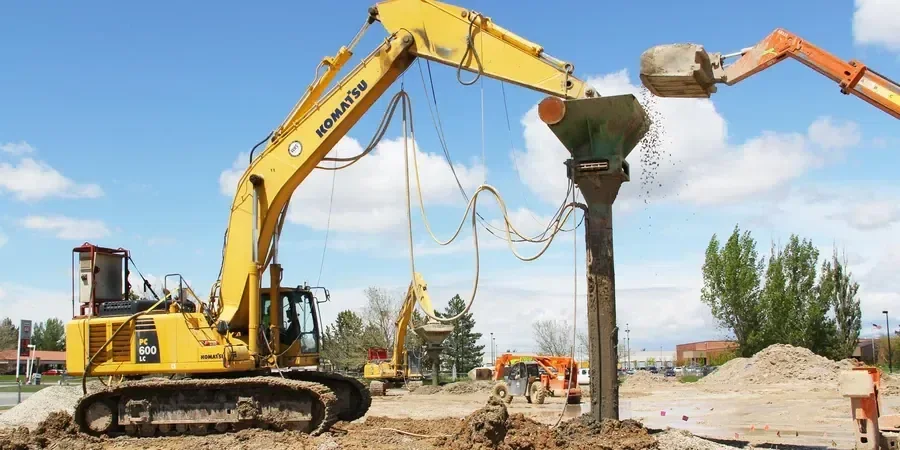
Wigan’s industrial past left more than just heritage—the ground beneath many sites here tells a story of deep coal workings, sporadic backfill, and glacial till that can vary from stiff boulder clay to loose sand lenses over just a few metres. In our knowledge, vibrocompaction design in this borough has to start with a careful desk study linking historical mining records to modern CPT data; otherwise the risk of differential settlement becomes very real. We routinely combine a CPT test profile with targeted boreholes to map the extent of uncompacted colliery spoil before specifying the vibrator spacing and energy input. For sites near the River Douglas corridor, where alluvial deposits soften the upper strata, we often integrate stone columns as a complementary treatment when fines content exceeds the vibrocompaction envelope, ensuring the foundation subgrade meets the stiffness targets required under Eurocode 7.
Real-time ammeter feedback during vibrocompaction lets us fine-tune compaction energy per point, avoiding both under-treatment and unnecessary cost—something fixed-prescription specs often miss in variable made-ground.
Process overview
The vibrocompaction rigs we mobilise around Greater Manchester are typically depth-controlled hydraulic vibrators capable of treating granular soils to depths of 15 to 20 metres, which covers most of the made-ground profiles we encounter in Wigan. The design process centres on a grid of compaction points—usually triangular spacing between 1.8 and 2.8 metres—derived from the relative density target, normally 70% to 85% for commercial and residential slabs. Water flushing is standard when treating dry sands in the Sherwood Sandstone-derived layers, while dry bottom-feed techniques are preferred in saturated zones to avoid pore-pressure build-up near existing structures. The key parameter we monitor is the ammeter-recorded peak current during each withdrawal step, because this gives a real-time proxy for densification resistance, allowing us to adjust the dwell time and lift height on the fly without waiting for post-treatment SPT verification alone.
Local context
Wigan sits on the Lancashire Coalfield; the British Geological Survey maps large swathes of the borough underlain by the Pennine Middle Coal Measures, with recorded mine entries and shallow unrecorded workings that create a legacy of collapse-prone voids and highly heterogeneous fill. When you apply vibrocompaction without a thorough mining-risk assessment, you risk triggering crown-hole collapse in old shafts or compacting a stiff crust over a hidden cavity—giving a false sense of improvement that fails under load. The glacial till cover is another variable: in pockets where it transitions from sandy-gravelly facies to a more clay-dominated matrix, vibrocompaction alone loses efficiency and lateral drainage becomes critical. Our designs always include a phased approach: preliminary grid with test panel, real-time monitoring, and post-treatment verification boreholes, because in Wigan the ground rarely reads the textbook and a generic design can leave residual settlement that costs far more to fix later than to prevent up front.
Quick answers
How much does vibrocompaction design and specification cost for a typical Wigan residential site?
For a small to medium residential plot in Wigan, the combined design, test panel supervision, and verification reporting typically falls in the range of £1,260 to £4,510, depending on the number of compaction points and the extent of pre-treatment ground investigation already available.
What depth of loose fill can vibrocompaction effectively treat in the Wigan area?
The hydraulic vibrators we use are effective to depths between 8 and 16 metres below ground level in the granular fills and natural sands common around Wigan; the limiting depth is usually dictated by the vibrator’s power and the presence of a competent bearing stratum to arrest the compaction effort.
Can vibrocompaction be used close to existing buildings in Wigan's terraced streets?
Yes, provided we set a peak particle velocity limit—typically 5 mm/s at the nearest foundation—and monitor vibration continuously during the initial passes. The triangular grid can be adjusted to an asymmetric layout to reduce energy input on the side facing sensitive structures.
How do you verify that the Improvement has met the design specification?
We compare pre-treatment and post-treatment in-situ test data, usually CPT soundings at the centroid of the compaction grid, and confirm that the target cone resistance or SPT N-value has been achieved across the full treatment depth. The results are documented in a verification report aligned with BS EN 1997-2.