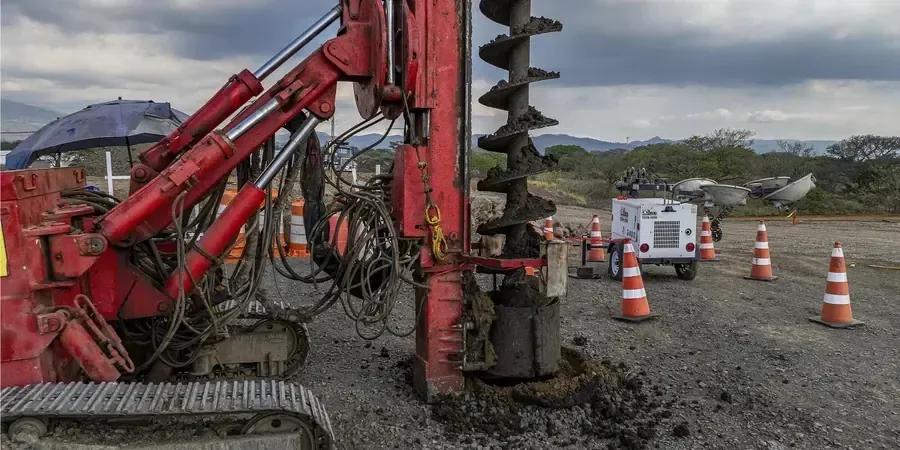
Wigan sits on complex geology. Coal Measures and glacial till dominate the subsurface, but pockets of soft alluvium along the Douglas Valley create serious bearing problems. The water table across the borough sits high, often within 2 metres of the surface in winter months. When a site investigation reveals undrained shear strengths below 30 kPa, conventional footings become uneconomical and deep foundations overkill. That is where stone column design comes in. We use the Priebe method and finite element analysis to size columns that transfer load through the soft layer into competent strata. Before committing to a full design, our lab team often recommends a CPT test to get a continuous strength profile, or test pits where access allows visual inspection of fill thickness and groundwater conditions. The goal is always the same: a Improvement scheme that reduces total settlement to under 25 mm for residential slabs and keeps differential movement within tolerable limits. BS EN 1997-1:2004 governs every calculation, backed by in-situ verification with plate load tests on working columns.
A well-designed stone column grid can cut foundation costs by 40 percent compared to piling, without sacrificing settlement performance.
Process overview
One mistake we see repeatedly on Wigan brownfield sites is assuming vibro-replacement works in any ground. It does not. In organic silts or peat lenses, stone columns lose lateral confinement and the column bulges under load. We learned this the hard way on a project near the Leeds-Liverpool canal, where untreated peat at 2.5 metres depth caused column failure during load testing. Now our design protocol starts with grain size distribution and Atterberg limits, then moves to a detailed settlement analysis using the unit cell concept. For sites with layered clays, we combine stone columns with a load transfer platform to spread stresses evenly. The
grain size analysis from our in-house lab tells us exactly what aggregate gradation works best for the native soil—too fine and the column clogs, too coarse and the stone interlock fails. We specify crushed limestone or basalt, angular, 25 to 75 mm, compacted in lifts of 600 mm. Each lift is verified by a site engineer with a calibrated depth recorder. The design output is a working drawing showing column grid, depth, diameter, and replacement ratio, ready for the contractor to execute.
Local context
On Wigan's former colliery land, unrecorded mine entries and backfilled shafts are the real wildcard. We have encountered voids at 6 metres that swallowed aggregate before any column could form. The design must account for these features, and that means a desk study of Coal Authority records before calculating column lengths. Also, in the Douglas Valley, organic silts produce excess pore pressure during column installation. Without a drainage path, short-term settlement can exceed predictions and the ground may not recover before the superstructure loads come on. We specify a mandatory pore pressure dissipation monitoring period of at least 7 days after installation in these zones. Another practical concern: vibration from the vibroflot can disturb neighbouring structures within 15 metres. Our designs always include a vibration monitoring plan and, where necessary, we switch to a dry bottom-feed method to keep amplitudes below 2 mm/s at the nearest foundation.
Reference standards
BS EN 1997-1:2004 (Eurocode 7: Geotechnical design), BS 5930:2015 (Code of practice for ground investigations), BS EN 14731:2005 (Execution of special geotechnical works – Ground treatment by deep vibration), ICE Specification for Ground Treatment (2011), BS 1377 (Visual-manual soil description, for site logging)
Quick answers
How much does stone column design cost for a typical Wigan site?
For a standard residential or light commercial project in the Wigan area, a full stone column design package generally ranges from £1,080 to £3,740. The final figure depends on the number of columns, the complexity of the ground profile, and whether supplementary investigation like CPT or lab testing is needed beforehand.
What ground conditions in Wigan are unsuitable for stone columns?
Stone columns do not perform well in peat, organic silts with loss on ignition above 10 percent, or very soft clays with undrained shear strength below 12 kPa. The Douglas Valley has pockets of these materials. We always run organic content tests and Atterberg limits before committing to a vibro-replacement design.
How long after installation can we start foundation construction?
On most Wigan sites with glacial till and Coal Measures clays, pore pressures dissipate within 3 to 5 days. We recommend a minimum 7-day waiting period in the Douglas Valley alluvial zone. A plate load test after this period confirms whether the columns have reached design stiffness. We will not sign off on foundation pours until the test passes.