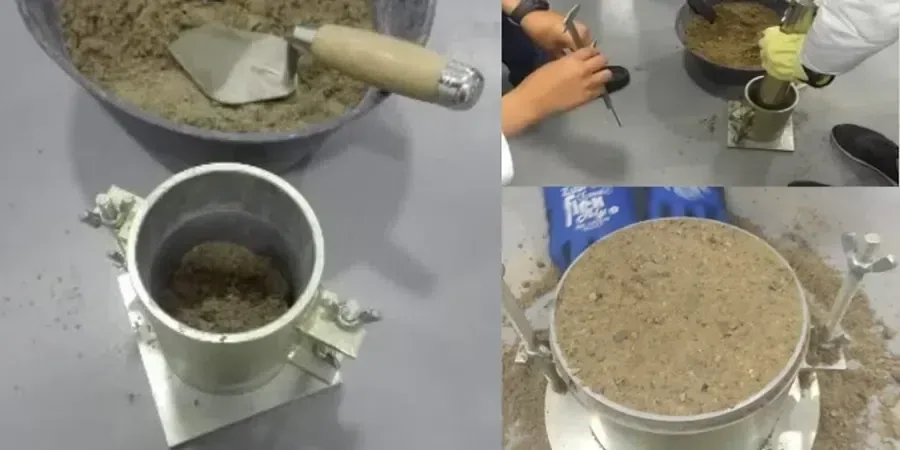
Wigan’s legacy of coal measures drift geology and post-industrial fill means the ground beneath a new access road or housing plot rarely behaves predictably. The Pennine rainfall, averaging over 900 mm a year across the borough, keeps near-surface moisture levels high through autumn and winter, so a specification density that looks achievable in August can become unworkable by November unless the relationship between water content and compaction energy is properly calibrated. We run the Proctor test — both Standard and Modified — in our UKAS-accredited laboratory on bulk samples taken directly from the formation, giving the contractor a defensible optimum moisture content and maximum dry density pair. For brownfield sites around Ince and Platt Bridge, where reworked colliery shale often masks soft spots, we frequently combine the Proctor determination with a sand cone density check on the first lift to confirm that field rolling is actually hitting the target.
Compaction is the cheapest strength gain per cubic metre you can buy — but only if the moisture content is within 2 % of optimum.
Local context
Much of Wigan sits on the Pennine Middle Coal Measures Formation, which weathers to a silty, micaceous sandy clay that is highly moisture-sensitive. The natural water content of shallow excavations in winter commonly sits 4–6 % above the Proctor optimum. Placing and compacting fill in that condition — even with a heavy padfoot roller — traps pore pressure, and the layer never achieves the specified air voids. The risk is not theoretical: we have seen platform settlements of 40–60 mm within the first wet season on schemes where the contractor rolled wet because the programme had no weather window. A single Proctor curve, run at the start of bulk earthworks on a representative bulk sample, costs a fraction of a re-compaction bill. When the fill source changes — say from a borrow pit in Billinge to a recycled crushed concrete supplier in Ashton-in-Makerfield — the optimum moisture content can shift by three percentage points, so re-testing is essential. The combination of a site-specific Proctor and a nuclear gauge or sand replacement field check keeps end-product specification earthworks on the right side of the compliance line.
Quick answers
When should I specify a Modified Proctor instead of the Standard test in Wigan?
Modified Proctor applies where the pavement or foundation design assumes a higher stiffness modulus — typically for heavily trafficked industrial yards, distribution centre floors or highway sub-base. The heavier 4.5 kg rammer energy better simulates modern vibratory rollers. For general landscape fill, residential estate platforms and trench reinstatement, the Standard Proctor is usually sufficient and more representative of the compactive effort achievable with a smaller ride-on roller.
What does a Proctor test cost for a typical Wigan brownfield site?
For a single-point determination (one material) you can expect to budget between £70 and £170, depending on whether you need Standard only or both Standard and Modified curves. The price covers sample preparation, the full five-point compaction run, moisture content oven-drying, and a signed PDF report. If the material contains significant oversize cobbles, there may be a small additional charge for the particle density and correction calculation.
How much sample do you need and how should it be taken?
We need about 25 kg of representative bulk sample in sealed heavy-duty bags to run both Standard and Modified compaction plus a moisture content check. Take it from the stockpile or formation immediately after excavation, avoid drying or wetting during transport, and label it with the date and proposed lift number. If the fill source changes during the job, submit a fresh sample because the optimum moisture content can shift markedly with gradation and clay fraction.