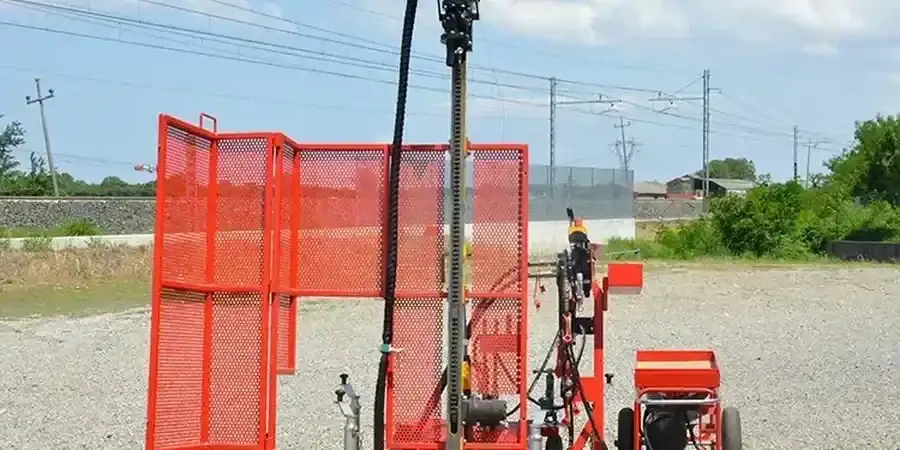
The split-spoon sampler drives into Wigan ground at 30 blows per 150 millimetres. A 63.5 kg automatic trip hammer drops 760 mm, recording penetration resistance every 75 mm. The rig sits on crawler tracks, manoeuvring through tight brownfield access off Wallgate or Scholes. We log the N-value against depth, note the groundwater strike, and bag disturbed samples for the lab. In Wigan, where the Middle Coal Measures weather to stiff clay and sandstone bands alternate with mudstone, the SPT blow count often jumps from 8 to refusal within a metre. That contrast matters for pile toe levels. The hammer energy is calibrated to BS EN ISO 22476-3, so the N60 value you see on the log is corrected, not raw. For sites near the Douglas valley, where alluvial silts mask the bedrock, we combine SPT with CPT testing to map the soft layer thickness before designing shallow foundations.
In Wigan, SPT refusal on sandstone can occur at 3 metres depth on one borehole and 11 metres on the next, 15 metres away. That is the Middle Coal Measures reality.
Local context
A five-storey apartment block on a former dye works off Miry Lane. The borehole log showed 4 metres of loose sandy fill with N-values of 3 to 6, then a thin band of soft alluvial clay where N dropped to 2. Below that, dense glacial till gave N=22 and weathered sandstone refusal at N=50/50 mm. The structural team had initially assumed a ground-bearing slab at 1.5 metres depth. The SPT data forced a complete redesign to CFA piles socketed into the till, bypassing the compressible upper layers. Without that single borehole and its SPT profile, the building would have settled differentially within the first wet winter. In Wigan, skipping the penetration test on brownfield land is not a cost saving. It is a liability that the NHBC warranty inspector will flag immediately.
Quick answers
What does an SPT test in Wigan typically cost?
For a standard SPT borehole in Wigan, budget between £460 and £650 per hole, depending on depth, access restrictions, and whether the rig is tracked or wheeled. That includes the engineer's time, the calibrated automatic hammer, sampling, groundwater observation, and the factual report with N60 values. Mobilisation to the site, traffic management on narrow terraced streets, and laboratory testing on disturbed samples are quoted separately after we review your site plan.
How deep do you need to drill for SPT in Wigan's Coal Measure geology?
Most Wigan investigations go to 10 or 15 metres, but the depth depends entirely on the site's mining history and the foundation type. For a shallow pad on a greenfield site near Standish, 5 metres into the glacial till might be enough. For a piled building on made ground near the town centre, we drill until we achieve SPT refusal (N>50) in competent sandstone or mudstone and then core at least 3 metres into the rock to prove it is not a floating boulder or a collapsed mine roof. The Coal Authority mining report is always cross-referenced before we set the final depth.
How quickly can I get SPT results after drilling in Wigan?
The field logs with raw N-values and groundwater observations are available the same day the rig demobilises. The final factual report with N60 energy-corrected values, exploratory hole location plan, and sample descriptions follows within 5 working days. If you need interpreted parameters for a tender submission, we can turn around the geotechnical interpretive report in 7 to 10 working days.