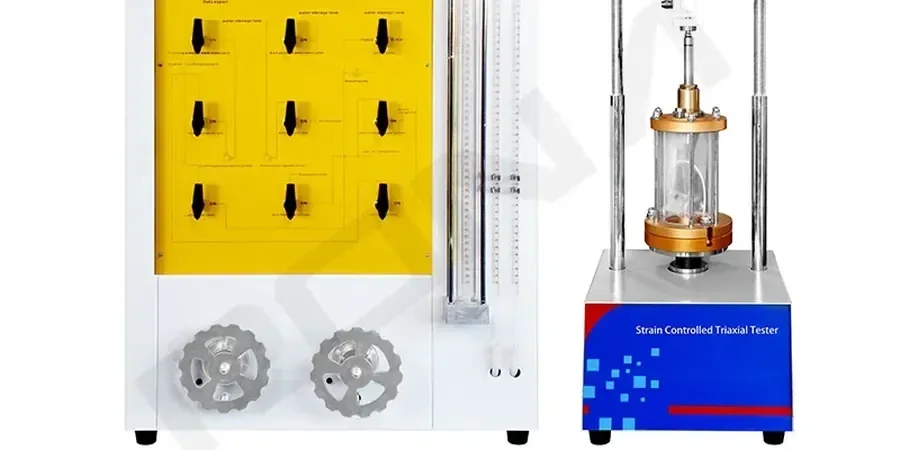
The triaxial cell sits in our loading frame, a cylindrical soil specimen sealed inside a rubber membrane and submerged in a water-filled chamber. What happens next depends entirely on the ground conditions in Wigan. A sample from the Middle Coal Measures, for instance, behaves very differently under confining pressure than a glacial till from the Douglas valley. Our lab runs three main triaxial configurations in Wigan: unconsolidated undrained for rapid construction checks, consolidated undrained with pore pressure measurement for effective stress analysis, and consolidated drained when long-term stability governs the design. For sites where granular layers complicate sampling, a prior CPT campaign gives us continuous stratigraphy and undrained strength ratios that feed directly into the triaxial testing programme.
A properly executed consolidated undrained triaxial test with pore pressure measurement gives you both total and effective stress parameters from a single specimen.
Local context
Wigan's development arc, from a cotton and coal town to a modern logistics and residential hub, has left a legacy of variable ground. Former pit yards, infilled canals, and shallow mine workings create pockets where undrained shear strength can drop abruptly. A triaxial test on a specimen from a single borehole depth provides a strength value at that point. The real engineering risk lies in extrapolating that value across a site without understanding the geological variability. Our lab couples the triaxial programme with index testing on adjacent depths so that the design team can map strength against lithology, not just depth. When a project encounters saturated silt bands within glacial till, we flag the effective stress friction angle as the governing parameter, because undrained conditions during construction can mobilise positive pore pressure and reduce the factor of safety on temporary excavations.
Quick answers
How much does a triaxial test cost in Wigan?
A single triaxial test on a 100 mm specimen, including consolidation, shear, and reporting, usually falls between £1,710 and £1,850. The final figure depends on whether you need a UU, CIU, or CID configuration, the number of confining stages, and whether we are preparing the specimen from a Shelby tube or a core sample.
When should I specify a CU test rather than a UU test?
Specify a CU test with pore pressure measurement when you need effective stress parameters (c' and ?') for long-term stability or when the construction sequence includes staged loading that allows partial drainage. A UU test is a faster, total-stress check suitable for short-term bearing capacity on saturated clay where no drainage occurs during construction.
How long does triaxial testing take from sample receipt to report?
A standard consolidated undrained triaxial test on a cohesive specimen requires 5 to 7 working days, including saturation, consolidation, and shear stages. Consolidated drained tests take longer because the shear rate must be slow enough to prevent pore pressure build-up; allow 10 to 14 working days for CD testing in Wigan's low-permeability glacial clays.