← Home · Improvement

Grouting design for Improvement across Wigan

Together, we solve the challenges of tomorrow.

READ MORE →

Wigan sits at an elevation of roughly 40 metres above sea level, but the real story is what lies beneath. The Coal Measures that drove this town's industrial rise left a legacy of shallow mine workings, bell pits, and variable fill — a challenge for any foundation or infrastructure scheme. A solid grouting design becomes essential when you're dealing with voids at depths of 5 to 25 metres beneath the surface. Our approach integrates historical mining records with modern site investigation to build a three-dimensional picture of the ground. In a borough where the River Douglas meanders across alluvial deposits, we combine grouting strategies with test pits to verify backfill composition and detect unmapped shafts before injection begins. Wigan's geology doesn't read like a textbook — it demands local interpretation.

In Wigan's Coal Measures, a grouting design that ignores mining history is a liability waiting for the next rainfall event.

Process overview

The contrast between Ince-in-Makerfield and Standish tells you everything about Wigan's subsurface. Ince sits on productive Middle Coal Measures with a history of intensive extraction; Standish, perched slightly higher, transitions into glacial till overlying the Wigan Four Foot seam. Designing grouting for the Ince area means targeting collapsed pillars and fractured roof strata, while a scheme nearer Standish often deals with more competent ground but deeper isolated workings. We specify cement-bentonite mixes for bulk void filling in the former and leaner, high-penetration microfine cements where fissure flow dominates. Throughout the borough, CPT testing helps us correlate injection pressures with in-situ density, refining the grouting design in real time. Every borehole log from Wigan reinforces the same lesson: you cannot assume continuity across a single postcode.
Grouting design for Improvement across Wigan
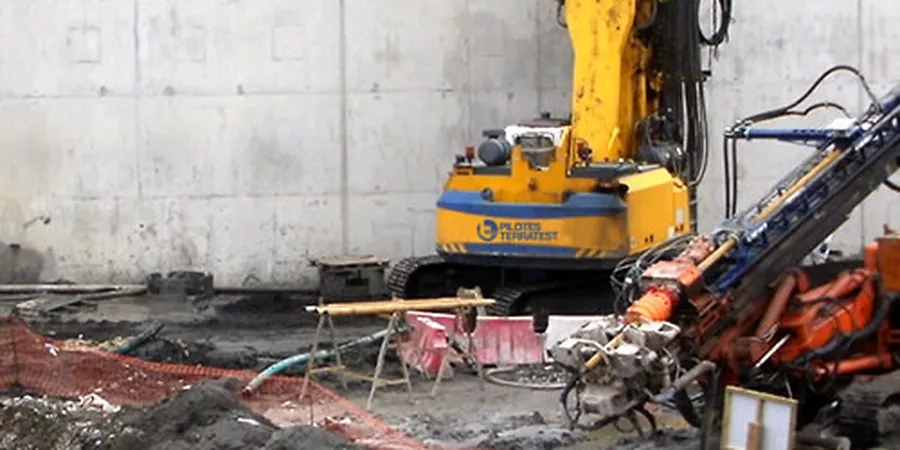
Technical reference image — Wigan

Local context

A three-storey residential block off Wallgate encountered a 2-metre void at just 8 metres depth during piling — a bell pit that didn't appear on any abandonment plan. The contractor paused work immediately. We deployed a stage-grouting sequence through the base of the contiguous piles, first filling the cavity with a low-mobility sanded grout, then pressure-grouting the surrounding fractured mudstone to create a homogeneous bearing stratum. Without that intervention, the pile could have punched through into the void under working load. Wigan's mining legacy is not theoretical; it shows up on site without warning. A proper grouting design must include contingency volumes and trigger levels for unexpected ground loss, because the historical record in this town is incomplete at best.

Need a geotechnical assessment?

Reply within 24h.

Email: contact@geotechnical-engineering.biz

Technical parameters


ParameterTypical value
Applicable British StandardBS EN 1997-1:2004 + UK National Annex
Site investigation codeBS 5930:2015 + A1:2020
Typical treatment depth (Wigan)5 – 25 m bgl (mine workings)
Common grout typesOPC-bentonite, microfine cement, chemical (polyurethane)
Injection pressure range0.2 – 2.5 MPa (formation-dependent)
Verification methodCore drilling + Lugeon/Packer testing
Settlement tolerance post-grouting< 10 mm differential over 15 m

Additional services

01

Mine void grouting design

Bulk infill design for shallow coal workings, bell pits, and adits using OPC-bentonite mixes. We calculate target volumes from historical mine plans and verify with probe drilling, adjusting the grouting design as encountered conditions dictate.

02

Permeation and compaction grouting

Microfine cement injection into glacial till and alluvial sands to reduce permeability and increase density. Suited for areas near the River Douglas where groundwater control is critical for excavation stability.

03

Verification and QA/QC programme

Post-injection coring, Lugeon testing, and settlement monitoring to confirm design assumptions. We produce a close-out report demonstrating compliance with BS EN 1997 and the project specification.

Reference standards

BS EN 1997-1:2004 (Eurocode 7, Geotechnical design), BS 5930:2015 + A1:2020 (Code of practice for ground investigations), BS 8081:2015 (Grouted anchors — although focused on anchors, relevant for grout durability), CIRIA C760 (Guidance on ground treatment)

Quick answers

What is the typical cost range for a grouting design package in Wigan?

For a standard residential or light commercial project in the Wigan area, a complete grouting design — including desk study, ground investigation interpretation, specification, and verification planning — generally falls between £1.120 and £2.880. The final figure depends on the number of boreholes, depth of treatment, and complexity of the mining legacy on site.

How do you confirm that mine voids have been fully filled?

We specify a combination of verification coring through the treated zone and water pressure testing (Lugeon or packer tests) to measure residual permeability. For larger schemes, we may add downhole camera inspection in selected boreholes to visually confirm grout travel into target voids.

Which grout mix is most suitable for Wigan's Coal Measures?

It depends on the void size and groundwater flow. For open cavities above 300 millimetres, a low-mobility OPC-bentonite-sand grout prevents excessive travel. Where fissures are tighter and water is moving, a stable microfine cement with controlled rheology gives better penetration without washout.

Can grouting be done while the building above is occupied?

Yes, we have designed staged grouting programmes for occupied structures in Wigan's town centre. The key is limiting injection pressure to avoid heave and sequencing the work in short stages with real-time monitoring. Access constraints often mean using portable rigs and hand-mixed grout for smaller internal operations.
Location and service area

We serve projects across Wigan and its metropolitan area.

View larger map