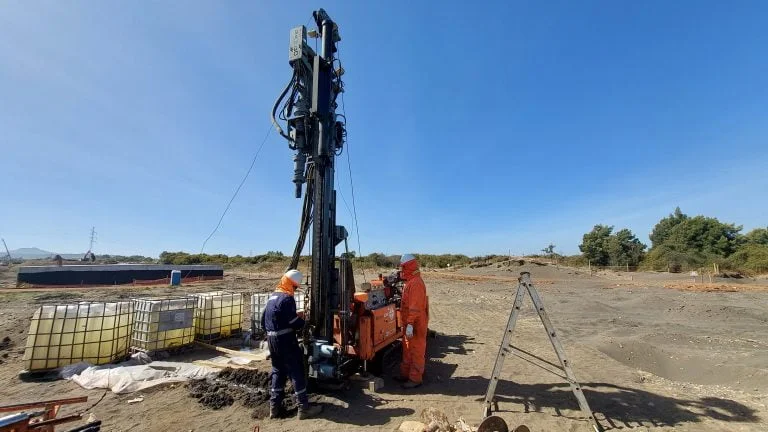
Ground conditions in Wigan don't follow council boundaries. If you've worked around the sandstone outcrops near Haigh Hall, you'll know the bedrock sits barely half a metre down in places. Head two miles south toward Pemberton, and you're suddenly in three metres of soft alluvial clay from the River Douglas floodplain. That contrast catches people out regularly. An exploratory test pit cuts through the guesswork. We open a trench, log the strata face-to-face, and take undisturbed samples right there on site. It's the quickest way to see what you're actually building on before a foundation design gets locked in. For deeper refusal verification or groundwater data, we often combine pits with SPT drilling to extend the profile beyond the pit base, especially in areas where the Middle Coal Measures weather inconsistently.
A test pit shows you the soil fabric in its real state — no remoulding, no extrapolation. What you see in the trench is what the foundation will sit on.
Local context
The excavator bucket breaks ground, and within twenty minutes you've got a vertical face revealing exactly what the last ice age left behind. In Wigan, that face can reveal lenses of running sand trapped between boulder clay layers — a condition that turns a straightforward pit into a hazard if the water pressure hasn't been accounted for. Our operators are trained to spot the warning signs: seepage at mid-depth, slumping at the toe, or fine sand boiling at the base. We don't enter unsupported excavations deeper than 1.2 metres. Period. Every pit gets a trench box or battered sides before anyone steps in to log the profile. The Health and Safety Executive's HSG150 guidance on excavation safety isn't a checklist for us — it's how we run every single site, no exceptions.
Quick answers
How long does an exploratory test pit take on a typical Wigan site?
A standard pit to 3.5 metres depth, including excavation, logging, sampling, and backfill, takes about half a day. Sites with multiple pits or difficult access — terraced streets in Scholes or back gardens in Standish — may stretch to a full day. We confirm the programme after a site walkover.
What do exploratory test pits cost in the Wigan area?
For a single machine-excavated test pit with full BS 5930 logging, sampling, and reinstatement, budget between £410 and £600. The range depends on depth, access constraints, and whether we need a trench box. Multiple pits on the same site bring the per-unit cost down.
Do you need traffic management for pits on the public highway?
Yes, if the pit location falls within the adopted highway. We coordinate with Wigan Council's highways team, submit the necessary notice under the New Roads and Street Works Act, and arrange temporary traffic control. The lead time for permits is typically five working days.
Can you take samples for contamination testing from a test pit?
Absolutely. We take discrete samples at depth intervals for chemical analysis — heavy metals, PAHs, asbestos screening — following the protocols in BS 10175. The pit method gives you better visual control over sample selection than windowless drilling, especially in made ground with brick fragments or ash fill.