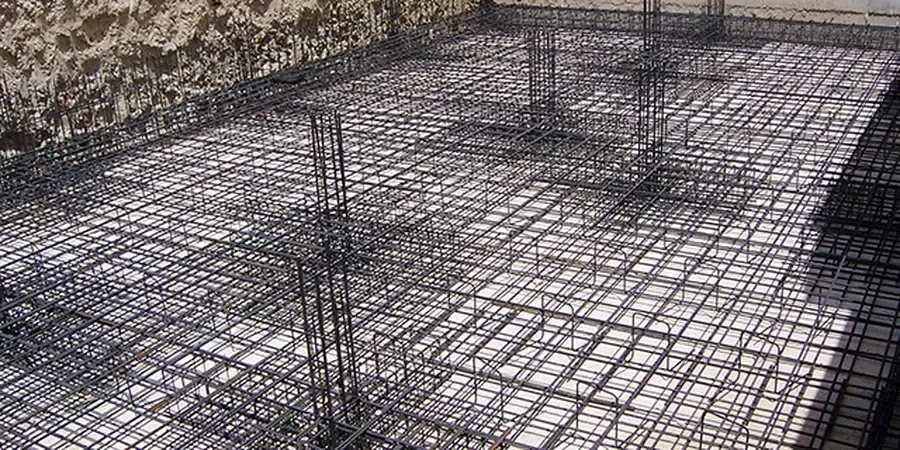
BS EN 1997-1:2004 and BS 5930 form the backbone of every raft foundation we design in Wigan. The town's industrial past and the underlying Wigan Four Foot and Orrell seams mean old workings, backfilled shafts, and unrecorded shallow mine entries are a routine part of our desktop study. You cannot assume competent bearing ground at uniform depth here. From the Douglas valley alluvium near Martland Mill to the glacial till over Coal Measures in Standish, we have seen six metres of soft organic silts over weathered sandstone in the same postcode. A raft/mat foundation bridges these transitions, spreading structural load so differential settlement stays within tolerable limits. Before committing to a raft, we often run a CPT test to profile soft lenses without disturbing the sample, then correlate the sleeve friction with local borehole records. We also draw on our in-situ permeability data to size any under-slab drainage blanket, which matters when you are building on the lower slopes of the Douglas valley.
A well-designed raft turns patchy ground into a uniform bearing surface, and in Wigan that matters more than most places.
Process overview
The contrast between Wigan's southern and northern ground conditions is stark. Down towards Ashton-in-Makerfield, the Middle Coal Measures produce stiff, overconsolidated clays that look solid in a window sample but can soften dramatically in a wet winter if the foundation level is not protected. North of the town centre, in Ince, alluvial sands and silts overlie shallow mine workings, and we have measured groundwater within 1.2 m of the surface in February, turning a straightforward excavation into a pumping exercise. A raft foundation handles both scenarios: in the south it bridges desiccated crusts and seasonal moisture variations, while in the north it acts as a rigid plate over loose, water-charged fills. Our design process always starts with a detailed desk study of Coal Authority records, followed by targeted sampling. We model the raft as a flexible or rigid plate depending on the stiffness ratio, checking bearing capacity, sliding, and overturning under the limit state combinations in BS EN 1997. Where the subgrade reaction modulus varies by more than 30% across the footprint, we zone the raft reinforcement accordingly, keeping steel ratios economic without compromising crack control.
Local context
We see a lot of sites in Wigan where the developer has already stripped the topsoil and hit black, reworked colliery spoil three metres thick. If you pour a raft directly onto that without proper compaction and gas protection, you are importing two problems: differential settlement from uncompacted fill and methane ingress from degrading coal remnants. The Coal Authority classifies much of the borough as Development High Risk Area, so a mine entry investigation is not optional—it is a planning condition. Our approach ties the raft reinforcement schedule to the findings of rotary open-hole probes that verify the position of any suspected shafts. Where voids are proven, we design the raft to span them as a structural slab, adding a geogrid-reinforced mattress beneath to act as a sacrificial bridging layer. Gas protection details, typically a ventilated void former or a continuous gas membrane lapped into the cavity trays, are integrated into the edge detail so the raft becomes both the foundation and the gas barrier.
Quick answers
What does a raft foundation design cost for a typical project in Wigan?
For a single dwelling or small commercial unit in the Wigan area, our design package—including the Coal Authority desk study, site walkover, CPT probing, and the signed structural calculations—typically falls between £890 and £3,800. The spread depends on the number of mine entry probes required and whether we need to model gas protection details.
Why choose a raft foundation over traditional strip footings in Wigan?
Strip footings work well on uniform, competent ground, but Wigan's geology is rarely uniform. Rafts bridge soft spots, reduce the number of individual excavations across potentially contaminated made ground, and provide inherent gas protection when detailed correctly. They also reduce the risk of differential settlement where backfilled shafts or variable fill thicknesses are present beneath the footprint.
How do you verify old mine workings before designing the raft?
We start with a Coal Authority mining report, then drill rotary open-hole probes at the positions of any recorded or suspected shafts within the building footprint and a 20 m influence zone. If voids are intersected, we log the depth, condition, and backfill material. The raft is then designed to span the void or, where the void is deep, we specify a reinforced granular mattress to bridge it before the raft is cast.